

HeyDaniko // November 9th, 2020
Dragon Age: Origins (2009)
I’ll preface this article by saying that despite being 11 years old at this point Dragon Age: Origins has aged remarkably well. Its graphics were never really the prettiest, especially when compared to Bioware’s other gem from the same era, Mass Effect. But in many ways its departure from focusing heavily on appearance and instead on story, combat, environmental design and mechanics may well have had a part to play in its slow ageing. Origins certainly feels traditional in that its combat is slow, with emphasis on thinking ahead and playing strategically. But “traditional” doesn’t necessarily mean “dated.” During my replay of the entire series just under a year ago, I never once felt like I was playing a game far removed from its halcyon days.
The first of the series, Origins was, and very much still is, a universally praised and adored game. And so, for me to sit here and just tell you that its good would be a waste of everyone’s time. Instead, I would like to do what any games journalist or blogger should do and tell you why its so good. How is it so good? What does Origins have many games seem to have lost in the decade since?
And truthfully, the short answer is “good writers,” or at least writers who were undeniably passionate about their project. The world and story of Origins are brilliantly realised and paced, and the characters evoke genuine emotions – from Duncan’s father-like-admiration, to Alistair’s loveable goofiness, and Loghain’s extremely slappable face. We care. We care so bloody much! We invest in our love, and in our hatred. We want to see more. And the fact that our decisions actually shape the world around us makes us want to care and invest all over again, just in a slightly different flavour.
Backtracking slightly, ironically, to my earlier mention of pacing and planning, I whole-heartedly believe that Origins is one of the most believable rise-to-power-and-fame fantasy stories out there. Nothing feels rushed or out of order. Your actions shape the world in real time, and everyone acts accordingly. After every playthrough, and I’ve had 3 or 4 at this point, I find myself wishing that the game was longer but having to remind myself that its only as long as it needs to be. And this desire for more of the same is likely the largest contributor towards why I so absolutely hated Dragon Age II the first time I played it.
Dragon Age II (2012)
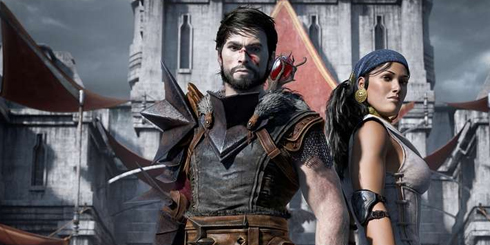
Which brings me neatly onto the much less neatly packaged sequel.
I have a lot to say about Dragon Age II, but I’m aware that most of it is just ranty noise that a few hundred thousand people have said before, so let me summarise; DA2 was certainly a disappointing sequel which felt much more like a spin-off and utterly divided the fan-base, but was it actually a bad game?
Well, if you’d have asked me 8 years ago, you’d have heard nothing but swearwords and the mad ravings of a scorned geek. But having so recently revisited the experience and knowing full-well what I was in for, I can honestly say, and I never thought I would hear myself say this, but “no.” It’s a genuinely decent game, but it sits thoroughly in the shadow of a predecessor that set the bar so damn high that no matter what followed, it was always going to disappoint.
All main points of criticism that the game received, both at and after release, remain valid, but I strongly believe that had the timelines of Origins and DA2 been reworked and reversed, then DA2’s story would have been met with a much warmer reception from both fans and critics.
To touch on some of those criticisms, one that I am totally onboard with is the opposition to time skips being used in a game that was advertised as “an epic set over 10 years.” This narrative device is frustratingly contrived at the best of the times, but in DA2 it just felt painfully lazy. And dishonest. But what did we expect? How do you write a decade’s worth of story material? Well apparently you write about a week or two at the start, then another week or two in the middle and finally, after another nifty time skip, you wrap it all up with a few climactic days. On top of that, nothing ever seemed to change during these skips. No one ever aged, bought different clothes or even wore a different hair style. Not once. If a helpful black screen hadn’t so graciously explained to us that events were now 5 years further on down the road, you’d have been forgiven for thinking that it was just the following Tuesday.
Another point of contention amongst the fan base was the change in combat mechanics, but I was very much in favour of these alterations. While Origins was a delicately paced, strategic take on role playing combat, DA2 was a much quicker, hack and slash more akin to a Dynasty Warriors or Devil May Cry game, but with role playing elements. And I loved it! It was by far my favourite part of the game, especially during the era that I pretty much hated every other aspect of it. The strategic elements of the combat were still very much present but in many ways much less necessary than in the previous title. But for too many fans this was just too big of a departure from what they had been expecting.
The final major bickering point of DA2 isn’t really an opinion as much as it is an extremely common observation – but far too many of the area designs were identical, almost identical or just outright excessively reused throughout. And for a game that had almost its entire plot set in a singular city and its suburbs, you’d think that some level of stress would have been put onto making sure that every cave and every tunnel was a different experience. Sadly, however, they all just blended into one. “Secret” hiding places weren’t exactly secret when they were all located in the exact same sub section of the under city, and you’d definitely think that bandits would stop hiding out in a particular cave after the second or third time the hero and his troupe of chums came murdering their way through. There were only around three or four different dungeon and basement environments, which may have flown under the radar had their exploration been optional. But when a countless number of quests repeatedly send you into identical maps, the recycling starts to become glaringly obvious, especially when many of these quests were unskippable story missions which had a real penchant for highlighting the lazy design.
In summary, DA2 is undoubtedly a flawed game but it does have just enough redeeming qualities to tip the balance ever so slightly back in its favour. For some, at least. The story is dark, fairly interesting and honestly a little something different from most other role players out there; the characters are charming and memorable; the combat is absolutely brilliant and it plays a very important role in setting the stage for what comes next.
Dragon Age: Inquisition (2014)
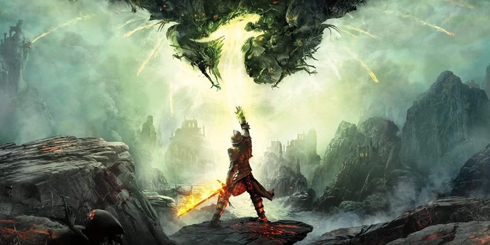
There really is no way to adequately summarise Inquisition other than to say that it was another divisive release in the series, but much less so than its predecessor. DA:I is nothing short of a Marmite experience with its players either falling utterly in love with it, or vomiting at the first 2 minute loading screen. Thankfully, I found myself in the former category.
Personally, I found Inquisition to be an epic experience, with a truly ambitious plot that manages to confuse and intrigue in equal measures. And at release it seemed like many critics felt the same way with a sterling array of positive reviews. But as the years went on I couldn’t help but notice the public opinion turn slightly from favourable to somewhat indignant. I often wonder if this was inevitable as people quite rapidly fell out of love with Bioware – firstly after Mass Effect: Andromeda failed to live up to the original trilogy, and secondly after Anthem even dared be born.
In the beginning Inquisition was hailed strongly as the game that DA2 really should have been, with the one major criticism it seemed to face being that it felt very much like a single player MMORPG experience. And in many ways I completely understand, especially as an Elder Scrolls Online player which often feels much like the same game, mechanics-wise. The world of DA:I is quite expansive, but often empty in a way that feels like other players should be populating it. More recent comments have been made about how the plot is confusing and too reliant on a particular DA2 DLC for context, which again isn’t untrue. Truthfully though, if you’re paying attention, and have been since Origins, then the story really isn’t that big of a head-scratcher. Yes, it gives you quite a few things to think about and brings back much of the politics of the first game, but if that’s not your flavour then role playing games maybe just aren’t for you.
Inquisition is a huge game. On my first playthrough I found myself breaking 100 hours just from exploring as much as I possibly could and ensuring that I didn’t miss anything important. And better yet, I actually enjoyed it. I never felt like the exploration was excessive and that I would rather be doing something else. Every map was something different than the last, something new and exciting to investigate. Exploration could even be rewarding with quests to find and characters to meet. I’m sure many will disagree with me and I welcome your difference of opinion, but if there is one thing that DA:I certainly cannot be accused of, its suffering from the same lazy and recycled design efforts as Dragon Age II.
Combat took a slightly different approach to both of the earlier titles and somewhat successfully seemed to marry the two. It was certainly much quicker in pace than Origins but pulled back on the reins a little when compared to DA2.
Of all its qualities however, my favourite aspect of the game was, and remains, the characters. Even the player character themselves, though left completely customisable, has a real sense of self thanks to the script writing and voice acting. Lightly put, you play an unlucky bystander dragged into someone else’s war by nothing but sheer misfortune, and end up forming and leading a holy army on a quest to save the world from a giant tear in the sky. And more often than not the dialogue even reflects on that with your character having the option to be utterly bewildered by this situation they have found themselves in, or, as I chose, to be a confident bad-ass and seize the moment like a real champion of justice and testosterone.
The rest of the cast are extremely diverse with everyone having something you’ll undoubtedly like and dislike about them, making them seem extremely human. Supporting characters are also incredibly charming and unique in their own ways with many memorable NPCs that you may even only see once.
And so I conclude with two simple yet poignant questions to the Dragon Age fan-base. Firstly, what were your ups and downs to the trilogy? And secondly, what do you truly want from Dragon Age 4?
I’ve been Daniko, and thank you kindly for your time.
 Thunder's Remnant