Fallout 76 in 2025

HeyDaniko // November 25th, 2025

It certainly isn’t lost on me that this article should probably have been written and posted about 18 months ago, back in April of last year. That would have capitalised on the surge of post–Fallout Season 1 traffic that the internet was drowning in. That same explosion of interest that pushed almost the entire Fallout series to the top of Steam’s best sellers’ chart for several weeks, and the same wave that sent Fallout 76’s concurrent player count through the roof, breaking its own record day after day for about a week. That would have been clever, wouldn’t it? But here we are. Hindsight really is 20–20.

All that being said, we’re now only about a month away from Fallout Season 2 landing on Prime Video. Season 1 was genuinely fantastic. It wasn’t flawless, but it was still one of the best “video game adaptations” we’ve ever had. Although, much like League of Legends’ Arcane, “adaptation” feels like the wrong descriptive entirely. The Fallout show isn’t a retelling of any existing Fallout story. It’s a completely separate and fully canonical entry into the universe.

Season 1 takes place in 2296, around a decade after Fallout 4, which is set in 2287 and remains the latest point in the game chronology. Fallout 76 (which I promise this article is actually about, just trust the process) is set in 2102, only 25 years after the bombs. It is, by a huge margin, the earliest entry, sitting nearly 200 years before Fallout 4 and the TV show. This, of course, doesn’t include the Fallout 4 prologue that takes place in 2077 when the bombs started falling, or the flashback sequences in the show. But is all this relevant? Loosely, yes. I hope.

Starting at the beginning, let’s address the elephant in the room: the fact that Fallout 76 had a preposterously dreadful launch, and, in all honesty, the problems started with the reveal. When Todd Howard took to the stage at E3 2018 to announce the game, the reception was “mixed” if we’re being generous. People weren’t convinced this was the right project to be making instead of a proper sequel like Fallout 5, a game that we still don’t have in 2025. It also looked very obviously adapted from and built on top of Fallout 4 as a foundation, with a large chunk of assets carried over wholesale.

Allegedly, Fallout 76 was born out of internal discussions about a multiplayer update or DLC for Fallout 4. And this explanation actually makes a lot of sense. We can only speculate as to whether the original idea was to retrofit Fallout 4’s entire campaign and make it co-operative friendly, or more likely, to add a narratively distinct multiplayer zone to the existing game. Other single-player titles have done this quite well. Rockstar built Grand Theft Auto Online into GTA V, and both Red Dead Redemption games had online components too. Even Metal Gear Solid V had Metal Gear Online. This obviously isn’t an exhaustive list of single-player games that experimented with multiplayer story modes, just some examples of narrative-adjacent online modes that found success. And Fallout 76 could very easily have ended up in this category.

But that isn’t what happened for several likely reasons. Firstly, Fallout 4 launched in late 2015. By mid-2018, releasing a multiplayer DLC or free co-op mode might not have made much of a splash, especially when 76 itself wouldn’t release for several more months. Secondly, and far more likely, the project simply grew far too large, probably very early in development.

The Appalachian setting of Fallout 76 is the largest map in the series, which it arguably needed to be since a server can host up to 24 players, who would otherwise be falling over each other on a smaller map. It’s also the most biodiverse Fallout world to date, with entire regions left untouched by the bombs, creating a striking contrast between the near-pristine forests and those classic Fallout wastelands. Building a world this large and varied was probably only achievable because the game originally promised to have no NPCs at all, heavily lessening the workload in that department. This was a fucking wild idea for a Bethesda RPG, even if it began life leaning more heavily toward survival crafting than roleplaying.

The original plan was for every character you met in Appalachia to be another player. Narratively, you were all emerging from the vault only 25 years after the bombs and were among the first people to begin rebuilding. It’s a premise that I can almost appreciate. Todd even stated that players would be filling the roles normally occupied by these missing NPCs, such as traders. And whilst that wasn’t technically untrue, since you can run a player shop from your CAMP, it was clearly not what people inferred from his comments. It was never realistic that players would, or even could, fill all of the traditional NPC roles that you would expect to see in a Fallout game, even if the servers could host enough players to feel like a living, breathing world. Quest givers, for example, a staple not only of Fallout but of RPGs in general, were damningly absent. As a result, the early story and quests were delivered through holotapes as you followed your wayward overseer’s trail. This presentation was hardly exciting and was met with just about all of the contempt that you’d expect.

This brings us neatly to one of Fallout 76’s biggest early issues – the fact that it didn’t seem to really know what kind of game it wanted to be. Innovation and genre hybridisation are great, but neither really apply here. It simply wasn’t RPG enough for long-time Fallout fans, and it was too much of a survival crafter for that same audience. Mandatory hunger and thirst management was unwelcome, especially since those mechanics had previously only existed in optional modes like New Vegas’ Hardcore mode or Fallout 4’s Survival mode – neither of which had been the default or preferred player experience for the vast majority of their audience. At the same time, 76 simply wasn’t enough of an alternative to the crafting genre incumbents, such as Minecraft, Ark, or Rust, with building being heavily limited, both structurally and geographically. It certainly wouldn’t be unfair to say that Fallout 76 just wasn’t the game that either of its target audiences actually wanted, and so it didn’t appeal strongly to anyone.

A quick but relevant side note: Bethesda originally only launched the PC version exclusively on the now defunct Bethesda Launcher, their short-lived in-house competitor to Steam. And, as expected, this massively gutted the game’s visibility. The launcher was so obscure, in fact, that when Bethesda announced its closure in May 2022, the news was met with vast numbers of people expressing that they had never even known about its existence. But perhaps that was a blessing in disguise. Who knows how much worse the game’s reception would have been if more people had actually played it at launch.

Given all of this, Fallout 76’s empty early world might have been better received as a free update for Fallout 4. But the sentiment would have been similar, and the mode would probably have been abandoned quickly. This is why I’m genuinely grateful that Bethesda released 76 as a standalone title, despite the state in which it launched. A failing DLC or update is easy to ignore, as Bethesda has proven a couple of times already. But a failing full game is not. The price tag and visibility forced Bethesda to dedicate years of fixes and updates to 76, which eventually transformed it into, dare I say, one of my favourite games.

Thankfully, I didn’t play Fallout 76 at launch, partly because of the overwhelmingly negative reception but also because I disliked spreading my library across multiple PC launchers – something that bothers me a little less these days. I only finally tried it in early 2023 after seeing a few Elder Scrolls Online creators dabble in it. And I really liked what I saw. Most of the updates that people had been praising genuinely seemed to be delivering. This obviously excludes Nuclear Winter, the doomed battle royale mode that was eventually removed. But with the Wastelanders update, roughly 18 months after launch, NPCs, human enemies, and character-given quests were finally added. It’s not uncommon to see Wastelanders described as Fallout 76’s soft relaunch, similar in spirit to what A Realm Reborn did for Final Fantasy XIV.

Seven months later, the Steel Dawn update brought about one of the most important changes to the survival mechanics. Hunger and thirst could no longer kill you. Instead, maintaining them granted buffs. This moved the game firmly toward the RPG that Fallout fans actually wanted it to be. These updates also introduced large quest lines and faction stories, the kind Bethesda excels at. Wastelanders gave us the Settlers versus Raiders arc, which many now consider to be the game’s main quest. And Steel Dawn began the two-part Brotherhood of Steel storyline, which concluded later with Steel Reign in July 2021.

Since then, Fallout 76’s content cadence has been largely hit after hit. New updates have added large narrative arcs, new features, new modes, fresh gear, rebalances, cooperative events, map expansions, and even a raid. Whilst Fallout 76 is not an MMO, largely due to the 24-player server limit, the DNA is absolutely there, and it’s clear to see the inspiration that Bethesda is drawing from and the direction they seem to be taking. At the time of writing, the game is on its twenty-fourth major content update, with the twenty-fifth arriving this December to coincide with Season 2 of the TV show. Update 25: Burning Springs promises the largest map expansion yet, taking us into Ohio. It will also include new bounty hunting missions featuring Cooper Howard, the Ghoul, portrayed by Walton Goggins, and previously only seen in the TV show. And since Fallout 76 takes place nearly two centuries earlier, I’m very curious to see how the character differs.

Of course, just because Fallout 76 has come a long way since its rough beginnings, that doesn’t mean it is free of issues. It can still be an extremely buggy mess. The problems range from classic Bethesda ragdoll physics, to falling through the map, random disconnections, lag spikes, quest breaking bugs, and always-enabled PvP that a large portion of the players have spent the last 7 years begging to be removed. Performance issues are mostly attributed to the aging Creation Engine, originally developed for Skyrim in the late 2000s. To make matters harder, the team behind the game, BattleCry Studios (renamed Bethesda Game Studios Austin in 2018), were tasked with modifying the Creation Engine to support multiplayer. They were essentially given tools built for a different purpose and told to make them work. And if the reports are true, they received far less help from the main Bethesda team than they probably needed.

One of the loudest complaints that you will often hear from players is, unsurprisingly, the monetisation. Whilst the game may be buy-to-play, and the subscription is technically optional, Fallout 76 is quite clearly engineered in such a way that playing without Fallout 1st is inconvenient at best, and intentionally unpleasant at worst. But this is how live service subscriptions usually work. Seldom do they offer genuinely premium benefits to entice in their buyers, instead preferring to monetise what should be the standard gameplay experience available to all.

Without Fallout 1st, which costs £11.99 per month or £99.99 per year, storage becomes an absolute nightmare. The subscription gives you access to the bottomless scrapbox, the only realistic way to store all of the crafting materials required for building your CAMPs, weapons, and armours. Without it, you are forced to use your regular stash, which has a limit of 1200 lbs. And this might sound like a lot, but considering the weight of your crafting materials, and just how much of them you will need in a game partly marketed as a crafting sandbox, you can easily fill your stash with what is, ostensibly, very, very little. This also has the added bane of then taking up what little space you have to store the surplus weapons and armour that you may need to keep for different builds or characters. This effectively means that if you don’t play with an active subscription you are going to be permanently encumbered and wasting enormous portions of your gaming time trying to play inventory management. At least in other crafting-centric games you can build additional storage boxes to place around your bases at will – but that can’t really be monetised now, can it?

Fallout 1st is also the only way in which you can effectively play the game in single player, as the subscription grants you access to a private server capable of hosting up to 8 players. Now, I wouldn’t really recommend playing Fallout 76 alone since the game isn’t really designed or balanced for it. But if you only care about the story and questlines, which I do think are genuinely quite good, then there’s really no harm in doing so. The game functions similarly to other live services and MMOs in that there are group and seasonal events that spawn around the map, typically not designed to be completed by singular characters. But I would argue that a solo, story-only, and preferably offline, mode should exist natively, disabling these cooperative group events for those players who don’t really care about them. Private servers for small friend groups could still be included in the subscription, as solo players wouldn’t feel exploited, and those who only want to play with their tight knit groups would be free to decide if being on a public server is really such a bad thing, That said, Bethesda clearly wants you to feel a certain way. And if even a small portion of people subscribe to Fallout 1st purely to play alone, then their greedy monetisation is unfortunately working.

Now, I know that the most fervent of defenders like to argue that, because we get all of the updates and expansions for free, this somehow justifies the overpriced subscription model. But many other players, myself included, would much rather buy the content packs at modest and fair DLC pricing, than be expected to pay for a hostile, rolling subscription that is designed solely to eliminate the carefully tailored tedium.

And lastly, we have the premium currency: Atoms. These are the true bane of all live service games, operating exactly the way you’d expect to see them everywhere else. The largest available pack of Atoms, frustratingly labelled “4000 (+1000)” instead of simply “5000”, is currently priced at £31.99 or $40. This works out at 125 Atoms per dollar, compared to the smallest pack of 500 Atoms sold for £3.99 or $5, where your dollar is only worth 100 Atoms. As always, this incentivises larger purchases through the perceived savings of buying in bulk.

Just to be clear though, one of the reasons that bulk buying (or wholesaling) works the way that it does in the real world is because it reduces the handling costs of the goods being sold. It also enables sellers to shift large quantities of product, prevents the build-up of surplus stock, and frees up inventory space for other goods, among a whole host of other economic advantages that allow the price per unit to drop.

Naturally, none of this applies to a digital product, which takes up no physical space and inconveniences no one if left unsold. To this end, you’re not actually getting more premium currency for your money when you buy the larger packs, but rather, you’re actively getting less value when you buy the smaller ones – a vindictive little corporate punishment delivered by the retailer because you didn’t give them as much money as they wanted you to.

I think it’s quite safe to say that my feelings on Fallout 76 are somewhat mixed. On the one hand, I do think it’s a genuinely enjoyable experience with friends, and it actually delivers some strong questlines and worthy narrative branches that I hope the franchise continues to acknowledge as canon in future releases. But in many ways, I’m almost grateful that public sentiment keeps leaning negative, because I really don’t want the future of Fallout as a whole to be live service–driven. Fallout is, first and foremost, a single-player role-playing franchise, though I would certainly welcome the addition of cooperative play in future titles, as long as it’s handled in the same way as Larian games, such as Baldur’s Gate 3 and Divinity: Original Sin 2. I would absolutely hate to see the predatory monetisation models of online-first live-service games begin to win out.

Not including the remaster of Oblivion earlier this year, the most recent releases in both of Bethesda’s most beloved franchises have been online games – Elder Scrolls Online in 2014 and Fallout 76 in 2018. It’s not unreasonable to worry that the reason we haven’t yet seen The Elder Scrolls VI, Fallout 5, or even a Fallout: New Vegas 2 is because Bethesda simply doesn’t feel the need to release them. We know that live service games can print disgusting amounts of money and rarely need to concern themselves with being a decent product in order to do so. And whilst I’ve played a great deal of both FO76 and ESO, I would be completely against either of them replacing what their franchises are supposed to be – and what the majority of their fans actually want to see.

I could easily allow this article to flow into a tangent of just how much I despise capitalism and consumerism, but its already taken me about a month to box this article off, so let’s just call it there. If you were on the fence about giving Fallout 76 a go, I hope this piece has served to push you in either direction. And if you do decide to play, then I hope you feel a little more equipped and understand just what to expect.

Thank you very much for your time. And I appreciate all comments, feedback, and corrections.

Daniko

Daniko’s “Top 10 Most Influential Games of All Time!” Part III (November 2024 Update)

HeyDaniko // Orignal: February 21st, 2023 // Update: November 25th, 2024

I know it feels a little weird that Part III only contains two entries, but these are by far the absolute beefiest chunks of the entire article. I did try to edit them down quite a bit, noticing that any and all semblance of formal register had completely buggered off, but I don’t know… I feel like the rambling is almost essential to the experience. It is just part of the flavour at this point.

In case you have missed them, you can find Part I here, along with Part II here.

9) Guild Wars 2 (& Guild Wars 1 in no small measure):

[ArenaNet – August, 2012 Global release]

I do love me some Fractals.

I played an incredible amount of the first Guild Wars from early 2006 until, pretty much, the time that Guild Wars 2 was due to release in 2012. But, despite it being one of my most anticipated games to date, I wasn’t actually able to play the sequel at launch. Sadly, the PC I had at the time was 7 years old and without a single upgrade. Near the end of its tenure, it was even struggling to run the original game so was, for lack of a better description, a complete spud. It was clearly long overdue for an update, and I think it would be quite dishonest to not attribute my ultimate tackling of that to Guild Wars 2. And, to a slightly lesser degree, Diablo III, which I had only been able to play at my friend’s house for around a year. Up until this point I had pretty much always been a console player first, and a PC gamer second if ever there was a title unavailable elsewhere. And this sudden change to PC-centric gaming was later reinforced by the terrible E3 we had to suffer through in 2013. I have yet to buy a console since the seventh generation and that E3 is largely, if not entirely, to blame.

Funnily enough through, on the topic of slow burners from my previous posts, I didn’t even really enjoy GW2 at first. Compared to the original game, the controls were extremely difficult for me to adjust to, as I wasn’t yet well versed enough in the use of keyboard and mouse for action orientated combat. The first game utilised a rather leisurely, slow-placed, tab target combat system. I almost never had to touch my mouse because pressing the space bar would allow my character to endlessly chase down his target and immediately begin his attack, never letting the foe escape. And all of my character abilities were bound to the number keys across the top, so never very far from where my fingers were resting. Additionally, once my initial target was down, pressing the C key would immediately target the next closest enemy, who I could then charge with another click of the space bar. So, after 6 years of such low effort play, I simply wasn’t ready for what ArenaNet decided to throw at us next. The second game changed everything, but most glaring was the combat system. Gone were the days of tab targeted, keyboard exclusive, relaxed gameplay, now replaced with a fast-paced, action combat design that suddenly required me to consider things like dodging and staying in or out of melee range. Without ever trying to imply that tab target combat requires less skill to play, action systems definitely feel considerably more demanding in terms of reaction time, spatial awareness, and the sheer number of buttons needing to be pressed at very specific times. But don’t come at me WoW players. I’ve seen how many buttons you have to press. That’s really not my point.

Guild Wars 2 has almost nothing in common with its predecessor. Whilst the first game is often loosely considered an MMORPG, simply because there isn’t really a more fitting, widely accepted category for it to fall into, the sequel is, without doubt, a genuine MMO experience. And honestly, in the beginning, I kind of hated that. There were people absolutely everywhere that I went. I was no longer able to play on my own or with my small, chosen group. There were no NPC companions either, something that I loved about the first game. I didn’t feel like the hero of the story anymore because I was now surrounded by hundreds of other heroes-of-the-story, all doing the exact same things in the exact same places. Of course, I have since come to discover that that is just kind of how MMOs are but, up until this point, I had been completely convinced that GW1 was representative of all MMOs, and I had no reason to believe that the sequel would be any different.

All this, compounded with a somewhat underwhelming base-game narrative, left Guild Wars 2 feeling like a real disappointment. And it was incredibly defeating to have waited years for a game that ended up being nothing like what I ever wanted, or needed, it to be. So, after a few brief adventures running around a now-unrecognisable Tyria, I simply stopped playing, with little-to-no intention of ever going back.

But all that changed a few months later in mid-2013, when my then-girlfriend decided to start playing, having been convinced to give it a go by a mutual friend. I wasn’t so upset with the game that I wasn’t willing to try it out again and play with them. And so, of course, in true slow-burner fashion, going back into the game with more understanding of both what it was and wasn’t, I found myself learning to love Guild Wars 2 for its own strengths at last. It was undoubtedly a completely different experience, and arguably designed for a very different audience given the scope of its changes, but once I was able to let go of ever wanting, or needing, a true continuation of the first game’s tone and atmosphere, I was able to appreciate the game for what it truly is.

But that’s not to say that I learned to love everything. Narratively, I still very much consider Guild Wars 2 to be a real disappointment. The first game certainly has its points of contention and understandable criticisms, but its sculped sense of scope and adventure, facilitated by small-scale, instanced gameplay, managed to carve out a notably emotive, epic, and memorable journey. The campaign of the base game alone, now referred to as Guild Wars: Prophecies, was absolutely massive. So massive in fact that my first playthrough of Prophecies easily touched on 200 or more hours of playtime before I reached its conclusion. This campaign alone saw us trek perilously across a post-war wasteland; frozen mountains and icy tundra; swamps and marshes laden with deadly, Australian wildlife; and hostile, blistering volcanic chains. And every step of the way something dramatic seemed to happen; maybe someone new would join you, or someone you had been traveling with would die. Maybe someone would betray you having lured you into their fold, or maybe someone else would extend the hand of friendships after several, previous conflicts. And keep in mind that the bulk of this experience was instanced. The only times you would ever see other players, outside of your adventuring party, were in the towns and outposts serving as social hubs. This format nurtured an ostensibly single-player-friendly yet cooperatively focussed experience, where the world felt rife with opposition whilst your party felt limited, overwhelmed, and outnumbered. Your personal involvement genuinely mattered. It was your job to lead this band of heroes and refugees across the world, saving whoever you possibly could and toppling whatever single foe or sinister organisation you encountered. And I fucking loved it! It was an emotional, extensive narrative, packed with great characters and wonderful, diverse places to explore. To this day, as of the November 2024 update to this article, Guild Wars 1 is still one of my absolute favourite video game adventures.

But that was just Prophecies, the first of three campaigns and a following expansion. So, if you add this initial, colossal odyssey to the later Factions, Nightfall, and Eye of the North adventures, all of which are admittedly smaller but still extensive in their own right, you have an absolutely, gargantuan narrative of sublime craftsmanship, that honestly hasn’t aged anywhere near badly enough for me to steer away from recommending it to you now. (The trilogy doesn’t include Eye of the North.)

But this article was supposed to be about Guild Wars 2. And it was, originally. You can thank my recent 2024 update for this seemingly unending deep dive into the games’ comparisons. And you can probably see where this is going.

Sadly, Guild Wars 2 didn’t just choose to fill all of its maps with the populace of the player base, but also downsized its visions of that scope and adventure many of us loved and yearned for. Traversing the world felt incredibly brief, contained, and formulaic by design, especially when compared to its goliath predecessor. And, mostly glaringly, all of the maps had been designed as quadrilaterals of varying descriptions, leaning away from the much more natural and free form layout of the original game. I’m sure there could well be programming and backend reasons for this, as I’m not a software developer, but just looking at the map from a its top-down perspective, there is something almost Minecraft-esq and voxel-like about the way each region is arranged and stacked like tetrominoes. We now have perfectly square mountain ranges used to draw various map borders that just feel off, especially when placed over a world map that many of us spent hundreds, even thousands, of hours exploring in a previous incarnation.

And that was just my initial, aesthetic complaint. Things didn’t get any better once I began delving into the narrative for the base game. Whilst I’ve come to love Guild Wars 2 for its visuals, combat, dungeons, raids, and PvP experiences, to this day the quality of its writing, especially when compared to the first game, still upsets me. There was no grand adventure, very few likeable characters, and no real growing sense of threat other than what we were first introduced to. It has certainly had some high points in subsequent content updates over the years, but the overall delivery of that initial story, the one that most players should be using to decide whether or not they’ll be sticking with the game, was genuinely pretty damn poor. Not least of which was how GW2 decided to replace actual cutscenes with two characters superimposed over a still background, spewing rigid lore and exposition at each other in the last engaging way possible. The original game’s take on cutscenes was far more immersive, seeing your party taken over by the engine’s AI, and shepherded around various locations amidst dialogue with assorted allies and NPCs. So, it took some real brute-forcing for me to see beyond these glaring devolutions and learn to find those aspects that I would later come to appreciate.

But back to 2013 when my ex and I and our mutual friend were, somehow, really quite hooked on this bloody game. Not quite a Bethesda open world calibre of hooking, but definitely not far off. We gradually managed to convince a small group of friends to pick it up too and, in very little time, we had our own decent crew going. Or ‘guild’ if you will. And as our hours in the game piled up we found ourselves joining the TeamSpeak server for our world, Vabbi, where we met, to put it politely, quite a colourful bunch. But I had originally been, really quite, adverse to ever joining another large voice server after having had something of a ropey and unpleasant experience on Ventrillo a few years earlier with my GW1 alliance. I was, however, eventually talked around, and I cannot overstate just how pivotal this one decision would go on to be in my later life.

And this is where the “importance” of Guild Wars 2 finally kicks in starts.

It’s funny to trace so many central moments in your life back to one, singular, profound instance, but that’s exactly what happened here. That decision, or maybe coercion, into joining Vabbi’s voice server would lead me to making some of the closest and most enduring friendships that I have ever had. A group that I still regularly play Guild Wars 2, D&D, and various other games with, to this day. Over 10 whole years later! Many of whom I have even had the pleasure of meeting in person over the years, either locally, or during a few brief jaunts around the world. I even attribute the very fact that I was able to relocate to Asia to having such a strong group of online friends. Knowing that wherever I went I would always have access to same group of people and the same hobbies that had been keeping me going for several years made the whole process significantly easier than I think it ever would have been without them.

And that’s enough of the mushy shit.

So, although I took quite an extended break from GW2, it’s still a game that means an incredible amount to me and one that I will drop into whenever I can. And at the time of writing, it still remains one of my most played game of all time, clocking in at just about under six thousand hours I believe. Fucking hell. But, because I apparently have nothing better to do with my life, it is very steadily being gained upon by the following entry…

10) The Elder Scrolls Online:

[Zenimax Online Studios – April, 2014 Global release]

2019’s Elsweyr chapter was absolute peak ESO.

Now, I never wanted a second MMO. Honestly, one is enough of a chore. It’s ridiculous that we accept that these games require hundreds, if not thousands, of hours of play to get anything done whilst the majority of other releases last a fraction of that time. I worked out recently that had I never played either Guild Wars 2 or the Elder Scrolls Online, then their combined playtime would have allowed me to complete nearly 1,400 other games of average length. And that’s fucking horrible! I wish I’d never worked that out. Even if we ignore the soppy mention of friends made along the way and such, which, yeah, is probably a positive, I can at least be confident that playing these games so much has been some pretty great value for money. Whilst subscriptions and in-game cash shops exist for a reason, there is absolutely no way that they have cost me quite as much as 1,400 brand new AAA releases, as they’re 70 to 80 quid a pop these days.

But that’s still a lot of time invested regardless of how little it’s cost me overall. Those are hours I could have spent learning languages, or doing something creative, like woodworking, writing, or painting. All fulfilling activities in their own right, but all also considerably more likely to earn money than playing two bloody MMOs! (www.twitch.com/heydaniko. Ad revenue please! You can even F5 this page a few times too. That might help.)

All this to say that playing a second MMO for the MMO experience, silly as it sounds, was never the actual plan. I just wanted to play through ESO’s story because I’d heard it was quite good. And I liked Skyrim a lot. I even wrote about liking it a lot, several times.

But this was early 2020 which we all fondly remember as the year the world ended. I had some time off work due to being a teacher and the sudden start of the pandemic forcing parents to keep their kids at home. I wasn’t at all against having some time off, of course, especially back in the early days when we all, hilariously, assumed that Covid-19 would last around two months at worst. So, I found myself going back to Skyrim in order to kill some time, having so recently completed a full trilogy playthrough of Dragon Age. But I was, sadly, a little fatigued with the game at this point. As much as I loved Skyrim and no matter how many new mods I installed, it was something that I think I was going back to a little too often, and never really giving myself time to miss. So, I got talking to a friend who had previously played through ESO just for the story – something I had wanted to do for a little while. I had briefly dabbled in the game a few years earlier, but Steam would attest that I had only made it 14 hours in. I’m sure people remember the rocky state that the game launched in. But my friend, the most recently of a few, confirmed that she found the story really quite good and that, if I was tired of Skyrim, it was well worth a go. Around the same time, I was also a Patreon subscriber of the Skyrim mod author Joseph Russell, most well-known for creating Lucien the follower. I had dropped in and out of Joseph’s streams a few times to catch him playing a little bit of ESO and I was definitely feeling like maybe it was time to have a tackle of the story myself.

And, again, you can see where this is going, because I am nothing if not predictable.

What began as a simple attempt to experience the narrative and the world of the Elder Scrolls Online did, indeed, end up turning into a second, full blown MMO addiction.

But it didn’t happen overnight.

I actually managed to play the game solo for a good few months, just enjoying the quests and the scenery, some of which I covered in my previous ESO article here. But after some time, I decided to ask around in the various ESO social media circles about guilds with active members on my time zone. I ended up joining a guild that I am still with to this day, with members all over the world covering all active time zones. And whilst folks have come and gone over the last 4 years, there have been an incredible number of static faces who have, somehow, managed to train me up from casual quester into veteran raid healer. Though I am not entirely sure how or when I let that happened.

Now, the majority of my ESO playtime was clocked over the years of 2021 & 2022, which most of my nearest and dearest will know to have been a rather difficult time in my life. This is where the game gets slightly elevated from “just another title that I really enjoyed” to something that has made a real impact on me. Having something to sink my time and energy into whilst being otherwise unable to do very much else was an incredible distraction for someone living with chronic illness. I had, of course, dropped back in and out of Guild Wars 2, and even Guild Wars 1, during this time but, after years of exhaustive play, there just wasn’t enough content to keep me busy. And that is where ESO shines. The amount of content it has these days is absolutely staggering. Especially if you’re a newer player or someone just interested in questing and exploring. But it’s definitely no slouch in the group content department either.

And much like my experiences with GW2, I have made plenty of great friends through ESO. Whilst I haven’t yet known most of these people very long by comparison, the times I have spent with them both in and out of the game have been just as memorable and rewarding.

So, please imagine some gruff, manly noises here to compensate for having emotions.

And that’s it! That’s the article done. How do I get all that time back? No more mammoth essays for me, I think. Smaller, more manageable opinion pieces going forward.

But if you made it to the end, over all 6.5 thousand words (2013 numbers, as I haven’t calculated the 2024 update), then I have nothing but appreciation for your time. Please feel free to let me know which games left the biggest impact on your life. It’s a topic I never tire of talking about.

Thank you again, very, very much,

Daniko

Daniko’s “Top 10 Most Influential Games of All Time!” Part II

HeyDaniko // February 20th, 2023

Thank you very much for caring enough to check out the second part of this article. Unless of course this is the first part you have seen. In which case, please, start at the beginning!

5) Call of Duty 4 – Modern Warfare:

[Infinity Ward – November, 2007 European release]

Iconic.

Say what you will about what the Call of Duty franchise has become over the last decade, but I will not hear a bad word said about the original Modern Warfare trilogy!

Before Modern Warfare, first person games were something that I actively went out of my way to avoid. Quite angrily. And, whilst I still confess to having little to no love for the perspective, preferring third person cameras in absolutely every scenario, first person games are something that I have learned to live with. This being, mostly, thanks to Call of Duty 4 and my old housemate, Dave, who managed to talk me into trying it when no one else could. There was something about FPS games that I had never been able to warm to and, as a result, the control scheme always felt alien and counter-intuitive to me. I would take a single step forward or backward with the left stick and then stop, hesitate, and turn left or right with the right stick. It took me quite some time to pair both the movement and camera controls into a single, fluid action at the front of my mind. But I did eventually get there… until I had to learn it all over again when I moved to PC years later.

But the reason that CoD4 will always be extremely important to me is that it opened up access to so many of my now-favourites – games that I would have likely completely skipped otherwise. If not for Modern Warfare, I would have never picked up Fallout 3, Borderlands, Deus Ex: Human Revolution, and possibly not even Skyrim (though I do refuse to play it in first person.) All of these games have left impressions on me in some small way or another, and so the idea that I would have intentionally overlooked them had I never been convinced to play CoD4 is quite a harrowing butterfly effect. So cheers, Dave!

Though not typically one for competitive multiplayer at the time, my housemates and I did rack up a good number of hours in the early days of those now infamous CoD lobbies. The game even became something of a staple as we prepared for nights out – pre-drinking from mid to late afternoon whilst smashing shots for every death we collected. And this usually made for a pretty cheap evening out as I was never very good.

6) Fallout 3:

[Bethesda Game Studios – October, 2008 PAL release]

Fallout 3 took me by absolute surprise. Similarly to how I had felt about starting Final Fantasy ten entries in, the idea of starting the Fallout series on episode three really did not sit well with me. I had also had some less-than-favourable experiences with Bethesda’s earlier games, Morrowind and Oblivion, that further hindered my excitement for the game. But one evening, whilst still living with the lot that introduced me to Modern Warfare and teenage alcoholism, I decided to sit and watch my housemate, Steve, play a few hours of Fallout 3. And I was intrigued. I ended up borrowing the game from him to begin my playthrough once he had finished, but had to return it a few weeks later at the end of the semester when it came time to move out. I remember hurrying to my local Gamestation and grabbing a preowned copy so that I could continue almost immediately. I even ordered the expansions on Amazon the same day, back when expansions could still be bought on disc. Good old 2009.

Fallout 3 was, looking back, the first time that I ever found myself with a genuinely disruptive addiction to a video game.

It’s obliviously happened again since, though. You know me.

I had so much trouble concentrating on anything else whilst I was away from my 360. Even at my old part time job in the local supermarket, I walked around like a heroin-addled zombie, daydreaming of sneaking around the wasteland with my sniper rifle loaded. Or looting abandoned schools, taking on gangs of Super Mutants, contemplating whether or not to nuke an entire town! It was a real problem, but there was no f*cking way I was going to admit it back then.

Finishing Fallout 3 was a real emotional shredding, as I had such an incredible hankering for more, but there was simply nothing available at the time that would quench my thirst.

So, ‘why is this on your list of most influential games?’ I hear you ask. Well, I think dependency counts as “influence” to some degree. Plus I’ll mention it again a little later, and you’ll see.

7) Borderlands:

[Gearbox Software – October, 2009 PAL release]

There have been many slow burners in my gaming history—games that I tried out only to take an immediate dislike to, or just find them a little tough to engage with, only to revisit them several months or years later and discover an unexpected appreciation that I never saw coming.

But no game compasses this quite like the original Borderlands.

I bought the game as a new release in the weeks after it first launched. I hadn’t been in much of a hurry given its middling reviews at the time, and the idea of an RPG being solely playable in first person. Boo. But a few friends of my mine managed to talk me into trying it out so that we could play co-op together. And those initial few sessions in a group were certainly a lot of fun as the game always was praised for its cooperative experience, but slated for how empty and sluggish it could feel alone. Sadly though, as the other two live in the States and I do not, our time-zone differences often meant that sessions together were few and far between. As a result, the game often found itself shelved for weeks at a time, as playing solo just wasn’t something I was particularly interested in doing.

But around a year after its release, I found myself trying Borderlands out once again, though I cannot actually remember who or what spurred me into doing so. And this time, something about going in and knowing what to expect, as well having seen public opinion swing slightly more in its favour, made the game a notably more enjoyable solo experience than I had found it those months before. But I wasn’t playing solo for very long. Over the following weeks, thanks to a combination of Xbox Live and Facebook oversharing, I discovered that a few more of my friends whom, at this point didn’t even known each other, were also playing the game. What came next was something of a bizarre collision of social circles as I found myself in a daily group made up of; someone I had met on a night out, the ex-fiancé of a girl I knew in university, an estranged friend from primary school and, occasionally, a guest appearance from the latter’s step father. So it really was quite the motley bunch, but our core group genuinely grew quite close over the busy months that followed.

Unfortunately though, our little crew didn’t manage to stay overly intact for the sequel due to life getting in the way for several people. One friend moved from Xbox to PlayStation, another moved house and had no internet access for what felt like forever, and I don’t even think the last one ever got around to even playing Borderlands 2. His step dad probably did though.

Still, the memories and friendships remain which… something, something… along the way!

8) The Elder Scrolls V – Skyrim:

[Bethesda Game StudiosNovember, 2011 Global first release. And then again on October, 2016; November, 2017; and November, 2021]

By now you’re probably tried of hearing me talk about how I hate not starting a series with its first entry but somehow managing to get over it and hop in later down the line anyway. So just insert those previous comments here and I’ll save us both some time.

Skyrim was not a game I was even remotely excited for. My previous attempts, years before, at playing the earlier games in the Elder Scrolls series had left a really sour taste in my mouth. And I don’t mean to intentionally belittle or slander either Morrowind or Oblivion, as they are both incredibly well-loved games and fully deserving of the fanbases that they have. But the gamer that I was at the time needed considerably more hand-holding than they were ever designed to offer, and this would quickly lead to a combination of frustration, confusion and, ultimately, boredom. Although, I do believe that if I were to revisit them, knowing what I know and with the experiences that I have with both open world RPGs and the Elder Scrolls lore, I would have quite a different opinion of them now.

That said, have you seen how badly Morrowind has aged? You could probably cut yourself on every NPC.

Thankfully, however, a good friend of mine made quite the flattering comparison between Skyrim and my much beloved, slightly addicted-to, Fallout 3. In his eyes, Skyrim felt much more akin to the previous Fallout games than it did to prior Elder Scrolls entries. And really, that was all I needed to hear to give it a spin. It had been a few years since my severe Fallout 3 addiction at this point, and sadly New Vegas just hadn’t hit the same high for me, which I am aware is a controversial statement on its own. So something to fill that void, and pick up where even another Fallout game could not, was extremely welcome.

And guess what…

It became a problematic addiction.

Nowadays I have lost count of how many Skyrim playthroughs, and partial playthroughs, I have had. But that first run, back in late 2011 into early 2012 – that left a bloody mark, man. And at this point in history Skyrim wasn’t yet the mega moddable, four-time released juggernaut that it would become. The mods were certainly out there and in development, but not in the way they are now, and certainly not on the old Xbox 360. I was just one guy, psychologically dependant on a Bethesda game for the second time in his life, and largely unable to function whenever removed from it. Again. Thankfully, at the time, I was working for a local video games store, which meant that I had no shortage of colleagues or customers with whom to brainstorm and rabbit-hole. Better yet, talking a game up to a customer who would then go on to buy that game from your store was actively appreciated by the management!

Skyrim is, to this day, still a game that I regularly revisit, and if you have not yet read my previous article on the game, I shall slam the link in right about here. Your eyes giving it a good oogling would be most appreciated. I shall not descend into frivolous justification for my Skyrim love here, as I am sure I’ll have nothing new to say that wasn’t already covered in the previous piece. So, if you wish to ingest further ramblings on this particular title, that’s where you’ll want to be.

And so ends Part II of an article doubtlessly responsible for numerous grey hairs around my chin. Part III will be available once I have finished trimming some of the fat. Its only two entries long but, my God, it’s wordy…

Lots of love,

Daniko

Daniko’s “Top 10 Most Influential Games of All Time!” Part I

HeyDaniko // February 19th, 2023

Foreword:

You might be surprised at how difficult it is to just sit down and write an opinion piece on your top 10 most important games to date. The urge to write about every single game I have ever loved was incredibly strong, and I must have omitted more than double the amount of entries that I actually accepted. Obviously any game you have a strong emotional response to is going to be important to you in some way and, arguably, quite influential in determining what you choose to play in the future. As a result it is certainly easy to equate loving a game to it being influential. But that really wasn’t what I wanted to explore with this article. I wanted to list the games that I believe had the most impact on my gaming history – the games that introduced me to genres, to consoles, to friends, and to experiences. Many of the following games on this list may have been considered my favourites once upon a time but, even after falling from that prestigious category, one thing they have all managed to retain is their impact. And whilst I could have quite easily made this list twice the length – I already feel like it might be a little too long. Plus, this article has taken me around 18 months to finish… So I think I need to focus of smaller, less sprawling topics going forward.

The games are listed in the chronological order that I believe I played them in, although its certainly possible that I have mixed some of the earlier entries up. In most cases, the order should also match their release years with a few, rather glaring, exceptions.

And, as always, feedback and comments are appreciated!

1) Pokémon Red:

[Game Freak – October, 1999 European release]

Red, Yellow and Blue listed in, probably, the order of how much I played them.

I’m beyond certain that back in my ancient youth, Pokémon Red was probably the first game I ever played with any kind of saveable progression. Prior to getting my first Game Boy, the humble silver Pocket model, the only games I had really ever played were on the Sega Mega Drive. That’s the Genesis to you folks across the pond, which, thinking about it would have actually been a more fitting name for it given its place in my gaming history. But, as important as the Megasis obviously is to me and my most beloved of hobbies, and as much as I enjoyed such classics as Sonic the Hedgehog, Ecco the Dolphin, and Desert Strike, the impermanent nature of my progression meant that I never really formed the tightest of bonds with those worlds or characters. But don’t get me wrong, the Gené Drive was a certifiably great console, and one that helped shepherd in our dominant age of addictive gaming. I have some extremely fond memories of early couch co-op with my friends, coming up with silly narrations for Sonic, or thinking we were amazing at fighting games because we’d successfully mastered the button-mash. But, ultimately, these experiences were largely social ones, and from the perspective of what gaming has come to mean to me in my current years, the games themselves were no more important or impactful than any other transient, shared experience – like a board game, card game, or one of those sports I’ve heard so much about. The entertainment was there, certainly, but the medium could have been replaced with almost any other social pastime. I never really felt any investment at all, or actually played to progress, and I barely remember even playing on the console by myself. I would just play to pass the time with others, but never really think anything more of the experience.

And so, along came Pokémon Red, with its mind-blowing save feature! And yes, I’m aware that that this wasn’t a revelation for Nintendo in any way, but for me it was the reinvention of sliced wheel. And a save feature wasn’t even something that had ever really crossed my mind. At no point did my child brain ever stop to think “wouldn’t it be great if I could come back to this game where I left off?” It was a completely new and alien concept, but one that welcomed with open arms. This, coupled with the fact that by this time I had been obsessed with the Pokémon anime for around a year, Pokémon Red was a guaranteed life changer. I just didn’t know it at the time. Red wasn’t only my introduction to saveable games, but also the entire role-playing genre – even now, my absolute biggest weakness. As it turned out, Red was, in fact, a gateway drug into just about everything that would follow. And whilst I only stuck with the Pokémon series for a few years, moving on from Red and Yellow, to Gold and Diamond, and honestly finishing with Ruby, none of them will ever hold that same special place in my heart that Red does – the game whose ripples can still be felt even today.

2) Golden Sun:

[Camelot Software Planning – February, 2002 European release]

I gave up trying to crop this one decently. You’ll get what you’re given.

Those who played Golden Sun and its sequel, The Lost Age, for the Game Boy Advance almost certainly remember them extremely fondly. They are often considered some of the best JRPGs that ever came out on handheld. And that’s an accolade well deserved. Golden Sun was my first real side-step into an RPG that wasn’t ruled by Pikachu. And whilst those earlier adventures amongst the Pocket Monsters had given me a taste of the genre, they hadn’t really prepared me for what else it had to offer. It was, in fact, the very presentation, story, and character development of Golden Sun that truly locked me into role-players, sealing off the partition in my heart that will, forever, be pre-allocated space. Golden Sun wasn’t just a game to 14-year-old me, it was an absolute experience. It felt considerably more like an interactive anime, or a movie, than anything I had played before. And as I wasn’t simply playing some nameless protagonist serving as an analogue for my own identity, I truly felt, for the first time, that sense of taking on the hero’s role and marching through their tale. I had real control over this immersive, interactive story, and it was the most engrossing thing in the world. Whilst I had absolutely loved the Pokémon games that I had binged before, they never really felt all that epic. And now looking back, the games always did have a tenancy to feel very formulaic and inconsequential. But Golden Sun was about the fate of the world! And whilst that trope might have been, and continues to be, done to death, for me is was awe inspiring. I was lost in the spectate of its unfolding story and vast lands. Even the visuals seemed a huge improvement from anything I had sunk my teeth into prior.

Completing the first game was the first time that I ever remember feeling that beautifully melancholic mix of pride and sorrow – that sensation of near regret and not knowing what to do with my life now that the experience was over. And this was a little more than a year before the equally captivating sequel would come out – a level of anticipation and excitement like nothing I had known before.

And wow, remember those days waiting 12 to 18 months for a sequel and thinking that was forever? How naïve we were, eh?

Sadly, I never did play the third instalment of Golden Sun all those years later when it finally released on the DS. Partly because handheld gaming had mostly lost its appeal to me by that point but also, slightly, because I hadn’t heard the most flattering things about it and was scared that it would spoil my fondness of the others. That said though, as it stands, my personal experiences with both Golden Sun and The Lost Age are something I will cherish for a long while yet.

3) Age of Empires II:

[Ensemble Studios – September, 1999 European release]

Although not my first dunk into the RTS genre, Age of Empires II was a hugely important part of my life during my middle teenage years. More than just a compelling strategy game with an engrossing campaign and endless replayability, AoE2 was also an incredible creative outlet. I lost count of how many hours, or days, I poured into the game’s scenario and campaign editor features over the years. Crafting my own worlds and building my own stories- I essentially used these features to construct my own isometric CRPGs before I even really knew they were a thing. There was something incredibly rewarding about watching my own narratives unfold before my eyes – not to say that they were ever any good, but I think they certainly helped spark a creative passion in my heart.

But I will say that the level of patience that I had back then, and my willingness to learn, through mostly trial-and-error, are qualities that I greatly lament ever losing.

Unfortunately that’s all the information you’re getting on my time with Emps 2, as to delve any deeper would mean exploring those attempted stories and utterly dreadful character names I dared to concoct. But I was weirdly proud of them at the time.

4) Final Fantasy X:

[SquareSoft – May, 2002 European release]

I was incredibly apprehensive about playing Final Fantasy X back in the day, and largely because I’ve never been a fan of starting a series part way through. It took me some serious research and convincing from friends to accept that the Final Fantasy series really wasn’t a sequential product in any way, and that starting with the 10th entry would not have felt awkward or out of place at all. And, naturally, those friends were right. As most people already know, the Final Fantasy games are completely set within their own universes and continuities – having no baring on each other whatsoever. With, of course, the exception of the numbered direct sequels and their spin off media, à la Final Fantasy X-2, Final Fantasy XIII-2 & Lightning Returns, and the “Compilation of Final Fantasy VII,” to name but the most notable. There have, however, been theories of late that the universes are all loosely connected as the result of a certain event that occurs in the XIII series and its sequel novel, but as nothing has been confirmed and the fanbase, en masse, accepts the games to be completely unmarried, that’s how things will remain for the time being.

God knows the world loves a Multiverse at the moment though.

What captivated me most about FFX was that it was my first RPG on a full sized console, as all my previous role playing adventures had been exclusive to the Nintendo handhelds. This added yet another level of scope that I had been completely unfamiliar with. Most notably the screen was larger than a mere few inches. Although, looking back at CRT televisions, it wasn’t the most incredible upgrade. There was also voice acting! For better or for worse that is, as FFX is known for having one of the most infamous segments in voice acting history, which you can enjoy here – HAHAHA. On the whole though, the voice over was more than adequate and a huge step up from the silence or blippy chirping that I was used to on the various Game Boys.

Whilst the Final Fantasy community often bickers about their favourite and least favourite entries in the series, FFX tends to be considered somewhere of a low high tier or a high medium tier contender. Many online and magazine-based articles often praise 10 as one of the greatest JRPGs on the PlayStation 2, whilst still stating that the previous generation’s 7, 8 and 9 were the superior games. Quite a large number even go an extra generation back and firmly attest that the series has never been the same since 5 and 6. But honestly, from what little I have played of the entire Final Fantasy catalogue, its genuinely all quite good. Being as wholly unrelated as every member of the family actually is, however, its no surprise that the fanbase is so divided. Final Fantasy X was my first venture into the ubiquitous series and probably still holds up as my favourite. Of the other entries that I have dabbled in, both Final Fantasys (Fantasies?) VI and VII didn’t really grab me when I first tried them, although I do fully intend to revisit them both at some point in the future; and I never did quite finish 8, though I did get within single digit hours of the end which is essentially 99% completion by RPG standards.

And that concludes Part I of my ridiculously time-consuming essay on personally influential games. Part II will be uploaded once I have the formatting and images all sorted so I hope to see you there!

Daniko

Idle Champions of the Forgotten Realms

HeyDaniko // October 3rd, 2022

It’s an extremely difficult thing to make a case for any idle game, as those who already play them know what they’re all about, whilst those you who don’t tend to see them as little more than games “that play themselves.” And whilst that categorisation certainly isn’t completely inaccurate, it is also more than a little reductive.

It’s true that the combat aspect of idlers tends to take care of itself, but what many prospective players don’t realise is just how much micromanagement actually goes into successfully progressing through a game like Idle Champions. And I am suddenly aware that a game about “micromanagement” probably has even less sex appeal than a game that runs itself but, please hear me out. This article is only about 1,500 words, so it won’t take long.

I often argue that a good idler can be an extremely rewarding second-monitor distraction, for those times when your main game is loading, or you’re just waiting in a dungeon queue. And Idle Champions of the Forgotten Realms just happens to be one such good idler.

In a nutshell, most idlers, sometimes even less flatteringly referred to as “clickers,” are about managing your team. You select your characters, each with different levels of damage, support, gold farm, etcetera, and you set them to work. The little guys will then go on about their business, automatically farming their way through enemies, zones, levels, adventures, whatever the format the game presents. Enemies will usually drop gold when defeated, which you, the player, yes, you are in fact required to play the game, can then use to level up your team. Classically, this was pretty much all idlers really had going for them, although that too is a little reductive. Idle Champions’ appeal, however, is in just how ways there are to empower your team of micro minions and allow them to progress further and further into the game as you go.

For a little background information, Idle Champions of the Forgotten Realms is an officially licensed Dungeons & Dragons video game, created by Canadian developer Codename Entertainment, and set in the D&D flagship fantasy setting of the Forgotten Realms. As the name suggests. What makes Idle Champs particularly alluring to D&D fans is the plethora of recognisable characters being continually introduced into its roster. And I’m not just talking about pre-established Forgotten Realms heroes like Minsc, Drizzt Do’Urden, and Jarlaxle, most well known for their appearances in the Baldur’s Gate series of games, as well as several novels that predate them, but the incredible number of player characters from the vast wealth of broadcast campaigns online. To name but a handful, heroes from the Black Dice Society, High Rollers, Acquisitions Incorporated, Waffle Crew, and, my personal favourite, Oxventure, all make an appearance with more heroes added on a month-to-month basis. And I’d be lying if I didn’t admit that Oxventure was the main pull for me, as there are currently no other places that I can get a fix of my beloved, dysfunctional vagabonds in digitised form. But there are doubtlessly countless other players who feel exactly the same about their chosen bands of heroes, sharing in my joy of seeing them animated on screen, chopping through wave after wave of opposing cannon fodder.

Presentationally, the game is arranged into “campaigns,” each taking place in a particular location, with its own narrative, and comprised of several “adventures.” These adventures are essentially levels in the old school understanding of video game structure, and each comes with a collection of “variants” adding different rewards, achievements, and challenges for their completion.

Importantly, progressing through Idle Champions requires a decent understanding of its chief grinding mechanic, and that is the endless feedback loop of gold find and favor. Working through any individual adventure will award you with gold. In the short term, this gold is used to upgrade your characters during that particular instance, allowing your team to push further and further into the waves of enemies. However, all of these upgrades are lost upon completion. In the long term, conversely, the total gold that you accumulate during any particular adventure is then converted into something called “favor” at the end. Much like the gold itself, favor also has two distinct uses. First and foremost, it increases the gold find that you begin any future adventure with by quite a staggering amount. With high amounts of favor accumulated, enemies who once rewarded you with 10, 100 or maybe even 1000 gold upon their defeat, will suddenly be shedding out millions, trillions, billions, and eventually whatever a billion times a billion is called, and beyond! This speeds up your progression through any particular campaign by an understandably incredible amount! But favor really becomes quite tactical when you start looking into using it as a currency. Blessings are campaign-wide buffs purchasable by spending favor. Some buffs remain active across all campaigns, but on the whole, most blessings only affect the campaign in which they are purchased. Whilst these buffs can be extremely powerful, increasing your team’s damage by hundreds, even thousands of percent, spending too much favor in one go could result in losing a noticeable amount of gold find during your adventures. The trick is to find that sweet spot in which massively accumulated piles of gold are no longer powerful enough on their own to brute force your way further and further into the adventure, or indeed the campaign. At this point, spending favor to purchase some blessings would be more beneficial than holding onto it purely for the sake of farming up more and more gold.

The Oxventurers and friends, with some guy in handcuffs.

In addition to using favor to build up more gold and gold to build up more favor, all the champions featured in the game have their own unique abilities, roles and specialisations. Just like the traditional role playing games from which all of the heroes are drawn, the characters are divided into their groupings of damage dealers, healers, tanks, and supports. Creating balanced teams that allow you to press on through the content is crucial to the game’s progression, much like any other RPG or MMO you might have played. Teams comprised exclusively of damage dealers may clear out the first hundred waves or so quite rapidly, but you’ll most certainly have an issue once your enemies start becoming more and more resistant to harm. At this point you’ll likely be needing a tank or two at the front of your formation to soak up the oncoming damage. But tanks alone cannot live forever, so just like in any good team composition, you’ll be needing the occasional healer placed throughout your group as well. Support champions are a little more specialised, however. Some provide the team with substantial damage boosts, increase the speed at which your heroes attack, decrease the time your skills require to cool down, and even increase the speed at which enemies spawn, allowing you to progress through the adventures much more quickly. Shockingly, some support champions even go so far as to increase your gold find even further than your accumulated favor does. This makes for some truly over powered farming teams that enable you to press through campaigns at quite a game-breaking rate. Only, it isn’t game-breaking, its just designed to feel that way for the cheap hit of serotonin we all crave so much. But, as we touched on earlier, even the almighty gold find has its limit. Striking a balance and finding a team that works best for you is one of the game’s key charms and certainly one of its more active aspects for those times that your main monitor game is loading. Or your tank is pooping.

Believe it or not, that’s not actually as deep as the rabbit hole goes, as there are even more customization choices and ingame rewards, all geared towards rapid, efficient farming and progression. But it would honestly be somewhat surplus and a little overwhelming, assuming the wall of information listed above isn’t already, to delve any further into the mechanics of Idle Champions. The chances are you won’t be worrying about feats, patrons, influence, trials, time gates, or events for quite some time after you begin playing, and by the time you do need to start paying them any attention, you’ll be well versed in the way the game handles and presents itself that you’ll have no trouble in figuring them out.

All this to say, please consider giving Idle Champions of the Forgotten Realms a spin, if only for something to do between levels, dungeons, raids, or even paragraphs as I have been doing for the last hour. You may just find it considerably more hands-on than the name suggests. If I had my way, the game wouldn’t even have “Idle” in its title. And the entire genre itself could even use a little PR as far too many potential players simply don’t understand just how much there is to do in these games. But as someone who has played quite a few idlers of the years, I feel genuinely comfortable in recommending Idle Champions as my favourite to date. And not just because it features the Oxventurers. Although that probably contributes.

It definitely contributes.

Lots of love,

Daniko

Oxventure Live at EGX 2022

HeyDaniko // September 28th, 2022

I certainly didn’t travel anywhere near as far as those who flew from the States, the Netherlands, or even the frozen north of Scotland. But trekking down to London from Liverpool for my first real outing in nearly two years was quite the adventure indeed. And incredibly worth it, thankfully, as I will now attempt to elaborate upon.

For context, not sympathy, I have been largely housebound for the last 18 months having been diagnosed with Fibromyalgia whilst living abroad. Sadly, this put my life on indefinite hold as I was forced to reluctantly move back to the UK whilst I focussed on getting better. The ensuing collection of months that followed have been arduous, with any and all improvement I have felt only really happening within the last 6 to 8 weeks at the time of writing. Perhaps I’ll delve further into the difficulty of living with a chronic muscular skeletal condition in the future, as this article is most definitely intended to be a joyous one, not a miserable rant about sickness and a cumbersome, crumbling healthcare system. But I feel that it’s import you know that not only did I actually get out of bed this weekend, and not only did I put actual trousers on this weekend, but I actually travelled to an entirely different city and reclaimed a small remnant of the existence that I once had! And how bloody worth it it was!

So lets assume that if you’re reading this opinion piece you are either familiar Oxventure itself, or familiar with the other works of Outsidexbox and Outside Xtra. There is, of course, the third option that you are just a supportive friend glancing over this text because I sent you a link with a sad emoji, asking for validation. But, from this point on, I’m going to assume that you fall into one of the former classifications.

Oxboxtra has been an incredibly important part of my life these last 18 months, and I know it’s almost cliché to say at this point, but I feel like these guys really have helped me out during, easily, the absolute worst chapter of life. Hopefully ever. But with thousands of hours of backlog to catch up on, I’ve had very little excuse to be bored whilst stuck indoors since the beginning of 2021. I’m almost grateful that I was late to the Oxboxtra party as trying to catch up on literally everything has been an endless, mighty task.

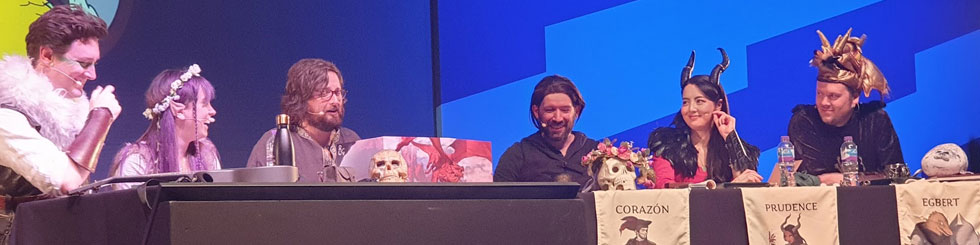
Left to Right: Luke Westaway as Dob, Ellen Rose as Merilwen, Johnny Chiodini as Literally Everyone Else in the World, Andy Farrant as Corazón De Ballena, Jane Douglas as Prudence, Mike Channell as Egbert the Careless, and Seal Gaiman as himself.

Whilst live Oxventures are hardly a new venture for the OX collective they did, unsurprisingly, take quite the hit over the pandemic. As it stands, I think these shows at EGX 2022 may have only been their second or third return to live performances since it became safe to do so. I missed the last group of shows at EGX in 2021 as I was simply far too sick to make the journey, but with my mild amount of improvement this year I was absolutely set on attending. So I took my hobble stick, packed two bags with honestly, in hindsight, far more than I needed for two days at an Expo, and hopped on the first reasonably priced train I could find heading south. And thankfully it ended up in London.

Friday at EGX was quite a quiet day on the floor although, from what others have told me, it was still considerably busier than last year. But it was nice to be able to meander slowly back and forth, not really worrying about getting in anyone’s way or having to circumnavigate cramped corners. And I wasn’t particularly interested in trying anything out, as Oxventure was the singular reason I was even attending the event. So come 6pm, the first show began, and without wanting to give any spoilers away, it was genuinely incredible. Now I’ve already said this to several friends, several times over the last several days, but I’m not entirely sure if was just my heightened emotional state of finally attending a live show, or if Friday night’s Oxventure was actually one of the greatest to date. The entire episode was absolutely hilarious, with some incredible moments of shear fan service as we were all treated to favoured NPCs, earlier adventure callbacks, and signature character moments. It was such a wonderful experience to be in that room with everyone else truly fortunate enough to be sharing the joy. Going into the show, I could feel my arms shaking, and desperately hoped that it was more of a sensation than I visible thing. Seeing these humans whom I already felt like I knew so well, in person, for the first time, was honestly a little overwhelming. And for that first show I was only two rows from the stage, so was absolutely within earshot of both Luke and Ellen. And so the show cracked on with, I think, a pace of about one or two gags a minute, which kept the room in complete stitches throughout. The guild, somehow, managed to have quite probably their toughest ever fight early in the adventure, only to follow it up with perhaps their most savage boss steam-rolling, as of yet, a little later. But the audience bloody lapped it up! Its hard to imagine that the fantasy themed comedy we were all subjected to was actually improvised, as the cast seamed genuinely incapable of missing a beat, with perfectly timed clap backs and slapstick moments from start to finish. Though not one of Oxventure’s more narrative heavy episodes, with no real connection to long-running arcs or antagonists, Friday’s show was still a near flawless demonstration of everything our friends at OX are capable of delivering. If you haven’t yet found that perfect video to send about your circles in the hopes of bringing them into the fold, I think you may just be onto a winner once this show goes up on YouTube. Although we could be waiting a while. And you may have to see my face.

And so, Saturday’s show had quite a bit of living up to do. Not that I doubted it could be done. But, for another mild deviation into my personal journey, I somehow ended up even luckier than I had done the evening before. A kindly security guard caught me seated in the queue, cradling my crutch so that no one passing would trip on it, and practically demanded that I move to the front with the other mobility-challenged attendees. Admittedly, it didn’t feel good, as my illness was never something that I had hoped to gain from in anyway, but I was then shepherded into the theatre and right along the front row. At this point it honestly became a little difficult to feel bad about my “fortune” as I was even closer to the action than I had been for the previous show.

And so it began. I could feel my nerves as intensely as the previous evening, waiting eagerly for our cast of charismatic journalists to take to the stage. As always, they introduced themselves with japes and quips before jumping readily into the action, fantasy, comedy slurry we were all there to bask in. And God, it was good! Whilst not quite as laugh-a-minute as Friday’s performance had been, Saturday’s show was still, undeniably, peak Oxventure! We had character-centric high jinks, gruesome enemy endings, and good old critical path deviations from pretty much the onset, with quite probably more video game mechanic-related humour than we have seen in Oxventure before. But I don’t think there was ever any danger of the jokes being lost on their audience of adoring nerds. If we took anything away from Saturday’s show at all, it was quite the hankering for a croissant. That, and Oxboxtra can, absolutely, always be expected to deliver on their promises of high-quality, hand crafted, extremely engaging entertainment, no matter which form it takes.

I have been Daniko, an unapologetically hardcore Outsidexbox and Outside Xtra fanboy, wishing you nothing less than a wonderful day. And don’t be a Dob.

http://www.youtube.com/oxventure

http://www.youtube.com/outsidexbox

http://www.youtube.com/outsidextra

Speed or Savor: A Slow Burn with Valheim

Fvnctional // March 31st, 2021

I’m a little bit late to the Thunder party, but having read the excellent work of my teammates here, I decided it was time to stop sitting on ideas and start writing them. Now, if you have kept your eyes or ears open over the past few months, it will have been hard to miss the V-game. Not Valorant, but Valheim. Iron Gate Studio’s new Viking exploration game. Or is it a settlement crafting game? Or a survival game? Or a boss fighter? The short answer is “yes.” The long answer is “yeeessss.”

I personally did not feel interested in Valheim when I first heard of it. That is because a lot of the charm of this game is impossible to convey through details alone. (At this point I wonder why I have chosen to write about this game if that truly is the case.) However, after hearing nothing but good things about it, I decided to take the plunge – cliché allowing. The price point is reasonable, but not insignificant. Thankfully, this particular game is a safe purchase as prospective buyers can get a very strong understanding of Valheim from the get-go and, making use of Steam’s refund policy, can play 2 hours, get an accurate feel for the game, and make the informed decision then. However, those 2 hours will be tricky, as time works a bit strangely when playing Valheim.

At this point we are all familiar with the notion of personal time travel when playing games; the famous ‘one more turn’ line of Sid Meier’s fame that somehow teleports players from 9pm to 4am has stretched its tendrils into almost every game genre, and Valheim is no different. In fact, Valheim is worse than most for this ability to suck players in. The core mechanic of Valheim is its growth, its progression system. You do [x] to get [y], which then allows you to do [z]. Rinse and repeat – it’s nothing new in gaming. However, Valheim’s tree of progression grows quickly, and the scope of what players are able to do can widen so swiftly that the satisfaction of the grind is never quite lost. “I just need to kill [x] enemy, which will unlock [y], allowing me to go and do [z], so that I can craft [I have run out of letters].” This is a blessing and a curse, as it keeps the player invested in the game, but it also encourages a play-to-win mentality where they are always chasing the next unlock, which is generally tied to defeating a boss.

I am sure that for some players, the progression-chaining idea of smashing out boss-fights is fun, but it undeniably causes the game to be over quicker. If we have learnt anything from the successes of openworlders like Nintendo’s Breath of the Wild, it’s that beating the main objective of a game does in no way mean that the player has completed the game, or even experienced what the game has to offer. Take Daniko’s nearest and dearest child, Skyrim for example. There is no way to play a game wrong per se, but if a player picks up an open-world RPG like Skyrim, plays through the main quest, finishes it, and then puts the game down having ‘completed’ it, they have somewhat missed the point of the game. As it so happens, this analogy fits Valheim well, where the best moments that the game has to offer are to be found not at the end, but along the way.

The world of Valheim is conceptually quite simple. There are different biomes to explore, each bringing with them different unique resources to farm, and different enemies to fight. Upon touching a new resource, the game informs the player of the new crafting recipes unlocked by obtaining said resource. The new crafting recipes facilitate greater survivability, and the ability to fight the next boss. This fuels the need for expansion in the game, and is relatively simple to get your head around. However, the spanner in the works is Valheim’s random seeds for the world that you play, in tandem with the sheer size of the game map. There is no guarantee that players will find the swamp biome necessary for their progression within even a vaguely close proximity to their starting location. The maps are seemingly random, which means that exploring is not just a core feature of the game, but it is the game. This is a hugely positive aspect of Valheim, as no two maps are the same, and, before players can progress through the game, they have to find their way first. This is where the meat of Valheim is found.

It is difficult to find a sweet spot in relation to Valheim’s progression. If players rush for objectives, they will finish the game and miss out on magical moments. On the other hand, savouring every moment of the playthrough can lead to stagnation, so it is arguably not ideal to actively put off fighting the next boss, or exploring the next biome. This piece is not meant to serve as a review of Valheim, (that comes later!) but instead talking about how best to enjoy it, and the difficulty of progression in sandbox playstyles. However, what I can say is that my favourite moment in Valheim by far was sitting in a shelter that I had built, cooking food over a fire, whilst the foulest, most awful thunderstorm raged on outside. At that point, I should have been fighting the next boss – I had the appropriate gear, and I knew their location. Despite that, though, I was enjoying myself, cooking meat in a cozy little house, out from the rain. My enjoyment of Valheim, just like the food I was poorly cooking, is a slow burn. – Fvnctional

XCOM: Chimera Squad

HeyDaniko // April 1st, 2021

I’m unsure just how much I have to say about Chimera Squad, and so it seemed like a safer bet to just jot down what’s on my mind and see if its enough to bother posting. So let’s see.

Sadly, I never did get around to uploading my old XCOM 2 article from my previous blog, which is something I may actually edit and move over in the near (or distant) future. It would have been nice to have had that article up here for some comparative points.

But where to start with Chimera Squad? First and foremost, please know that this game is NOT XCOM 3, and die-hard fans of the series should feel no more pressure to play it than they did The Bureau. That being said, it is the same genre and formula, so lends itself a little more familiarity with that. The Steam reviews for this game are by far some of the most accurate I have ever personally found for a game, with people claiming that Chimera Squad is little more than a watered down XCOM 2, or even pointing out that its more of an asset recycle than a game in its own right. Many players were left wanting more having come from the complexity and insane difficulty of XCOM 2, but none of this intrinsically makes Chimera Squad a bad game, just not the safest of purchases for fans.

The premade characters are both a boon and a blight on the game has their interactions with each other can often be quite humorous or even charming. Character interactions are something I’m a big fan of as I have mentioned in earlier articles. BUT, and this is a capital ‘but’ for a reason, the character creation of XCOM 2 was one of my, and thousands of other players’, favourite aspects of the game. Without having my gaming guild and buddies to take down alien invaders, I immediately felt a somewhat lack of investment in the narrative. Call me heartless but I’m more concerned about killing my friends than I am their stand-ins. The premade characters also come with another mild hiccup – a move from class based combat and abilities to character based one. Understandably this move was made to accommodate the fact that not all members of your team are human this time around, but locking characters down to their ‘unique’ skills (reused class based from XCOM 2) just doesn’t feel like a fun, constructive, or even diligent move in my opinion.

As for the shout about Chimera Squad mostly reusing old XCOM 2 assets, I think that much is apparent. With the probable exceptions of the human character roster and home base, just about everything else is identical to how it appeared in the previous title. Even the new alien allies are little more than slightly recoloured XCOM 2 enemies. Weapons, animations, skills, environments – pretty much everything appears to have just been lifted straight from the game’s ancestor.

On the plus side, I will say that the change in difficulty suited me a little more than the previous game, which was a fiendishly punishing experience without the right nooby mods. But everything else? Just a shadow of something much, much better.

On the whole, I would say that I enjoyed around 50% of my Chimera Squad playthough before feeling thoroughly burned out. The missions and “breach mode” are repetitive and tedious, and the story is largely forgettable. Its not terrible, in that I have played considerably worse games, but you will almost certainly be disappointed.

Cheers,

Daniko

Alpha Betas

Cheirinn // March 18th, 2021

In this day and age media services are exploding – expanding to provide the world with an array of varying sitcoms, dramas, serials, documentaries and other shows that appeal to the vast demographics. And, thanks to YouTube, everyday content creators don’t need to rely on Hollywood or production companies to make satisfying shows for people to watch. An especially notable case is that of YouTubers Evan “VanossGaming” Fong, Tyler “Wildcat” Wine, Marcel “BasicallyIDoWrk” Cunningham, and Brian “Terroriser” Hanby. They have each garnered their large viewership while providing videos that center around gaming and their commentaries. With their supportive fanbase, this quad set out to complete an even larger goal. With the creative minds of Chris Bruno and David Howard Lee, they planned on creating an actual show that they are hoping will be picked up by a network and adored by the populace. This idea of theirs is named “ALPHA BETAS”.

The pilot episode for Alpha Betas is currently available on VanossGaming’s YouTube channel, and can be found here. The story revolves around four gamers that are employed by the CIA to protect and maintain the power mainframe of the USA. The Energy Division that oversees them consists of a level-headed and serious superior, a friendly but slightly naïve assistant, and a snarky and annoyed supervisor. For the gamers themselves, the show does a quick bit in which the superior simplifies the characters to their one trait, of which each responds exactly as described. The cast for these characters does not rely on the four founding content creators alone. Though the main four characters are voiced by the aforementioned YouTubers, they were even able to get some actors to participate in their pilot episode, such as John DiMaggio (Futurama, Adventure Time, Gears of War), Chris Parnell (Archer, Rick and Morty), Paget Brewster (Criminal Minds), Stephanie Beatriz (Brooklyn Nine-Nine), and Brent Morin (Undatable).

The show is drawn extremely well and is smooth in its animations. Its style looks like a polished-up version of Rick and Morty or a variant of Final Space to me. It is clean and well-detailed, and each character has their own look. When it comes to the writing of the show, there was nothing really amazing about the story itself as the idea I feel is not extremely original. It appears to be a less serious and more edgy version of Code Lyoko. This, of course, has not deter me as I enjoyed the premise and the entirety of the pilot. The story itself both does and doesn’t make sense in certain cases and you are left thinking, “Why did they do that?” The voice acting was great all around except for Even Fong and Stephanie Beatriz in some parts. I felt that the emotion behind the words were missing and it sounded like they were just speaking the lines rather than trying to act out the lines. The best acting was done by Brian and Tyler, their voices were definitely made for this. The characters were all well written and entertaining in regard to the story, but I did not like the way that they made Chris Parnell’s character as it just felt like a re-skin of his character Jerry from Rick and Morty. This show does have a lot of potential and is completely worth the time to watch.

Though the pilot didn’t blast me away and is definitely not the best show out there, these guys performed much better than I expected. And I do hope that, with a little more work, Alpha Betas can be picked up by an actual network. I have a strong respect for Tyler in his comment on Twitter in which he says, “… Thank you guys so much! Just so you know that the pilot is always the worst episode of a series. This show will only get better if we get to make more seasons. Promise you that!” Of which he is right. What made me respect him in this case is the awareness that what they made is not perfect nor the best, and that they are ready to improve and continue on with the project for their fans. It is great to see people not be full of themselves and to be grateful to those that are supporting them on their journey. Please give this show a chance and support them as they continue to provide this show for free.

NOW, ON TO THE SPOILERS!

YOU HAVE BEEN WARNED.

I am not going to tell you everything that happened in the show, not that kind of spoiler. Rather I am going to talk about certain things that happened in the show that I thought were notable, for good or bad reasons.

I will start off with the problems I had with the show. The biggest gripe I had with the show was the rationale behind the “antagonist”. If the whole purpose was to fire the Alpha Betas, just referred to in the show as Alpha Team, then why go through the whole process of creating a ruse to try and make them fail? Just fire them.

I understand that there needs to be hidden tension or a mystery aspect to some shows to make them interesting and to have the story move forward without needing a lengthy or complicated explanation, but this just seemed ridiculous. The story I feel would have been better if the Alpha Betas were aware that their superior hated them and wanted them fired, and that they had to feel the pressure of not messing up to be replaced with Bravo Team. OR, that they are aware that Bravo Team “exists”, but think that they are a foreign entity trying to destroy America which would allow for the mystery aspect to take place as they discover things that show that it is not a foreign power, but their own boss trying to sabotage them.

I felt that the superior could have easily just said to the Alpha Betas that Bravo Team performs better and quicker, so we are letting you go. Or, they could have just killed Alpha Team like they did with the auditor, which also made no sense as he was sent by the president and thus him disappearing would cause even more problems for the superior. I am assuming that the next episode they will have a robot or clone of the auditor to cover their tracks, but still bad writing.

Also, why try to do this plan while the auditor is there? If they needed a witness, they could easily show video recording of the teams’ failure as they execute their plan at another time. Why jeopardize your funding just to fire four successful incompetents? Make no sense, but still lead to an entertaining episode and gave them a reason to explain the premise and purpose of the team to the audience.

There were other smaller things in the show that were either out of place or annoying, but not big enough to cause any larger care than a confused expression or an eye-roll. Such as making fun of Buck’s legs when he said there are too many bandits to blast their way in. Or, Eddie refusing to shoot the hooker to impress Ruby who said she didn’t care if he shot a fake hooker (which was only put in to make the scene more suspenseful and tie back to the beginning).

For the good parts of the show, the show did well in making the world interesting and I am looking forward to seeing if we can meet other country’s Energy Division teams. The show did not make me feel bored and I really enjoyed the feel that the characters had. The explanation given in the show for the purpose of the Alpha Betas was enjoyable and made me chuckle at some parts. Such as trying to get power from a waterfall only to be electrocuted. I did not think that showing the Area 51 scenes needed to be so focused on, but now I am intrigued on if the aliens are a one-time thing for the pilot or if we will see more of them. I mean, c’mon. What is gonna happen to Ed and Lisa? Will she ever get back home to her family? I need to know.

The show did have some funny parts to it, but not enough I felt. Then again, the main aspect for the story may not be comedy, but more episode will give us a better feel of their direction. I especially enjoyed Tyler’s character Tommy trying to overcome his fear of horses to just be murdered by the horse. The show does a great job of making you feel invested and wanting more.

Overall, I would give the show a solid B, but please take the time to watch for yourselves. Maybe I am dead wrong on my critiques. You be the judge for yourself. All in all, I think you won’t be disappointed. Thank you all for reading. This has been Clayton. Take care.

17 New Games From The Game Awards

OneMoreYear// January 8th, 2021

If you are someone who considers themselves a gamer, you may have noticed that The Game Awards recently happened. And if you are anything like me, you were not in it for the awards, but for the game announcements. Unfortunately, there was no trailer, or information for the highly anticipated FromSoftware project ‘Elden Ring’ which is surprising to a lot of us, considering that development on the game began back in 2017 after the release of the ‘Dark Souls III’ expansion ‘The Ringed City’, so to not even see any gameplay by now is a little concerning. Perhaps having the notoriously leisurely George R.R. Martin on board as a co-writer is contributing to this.

That aside, let’s get on to the new titles that were announced at The Game Awards, I will be covering them in order that they appeared in the show

Perfect Dark (Xbox Series X/S – Windows)

The first game to be shown was a reboot of the 20-year-old IP, first developed by Rare, now being made by Xbox’s shiny new studio in Santa Monica The Initiative. The trailer has viewers onboard a drone, flying through a futuristic Egypt, and traversing the hallways of a corporate building, showing a path of destruction presumably left behind by Joanna Dark herself, as we see her standing atop the building, gazing out at a storm raging behind the pyramids. While as interesting as it looks, we didn’t see any gameplay, and seeing as The Initiative is a new studio, there isn’t a lot to say in what to expect. Nonetheless, I am sure this is exciting for fans of the series.

Back4Blood (Xbox One, Series X/S, Windows, PS4, PS5) June 22nd, 2021.

I have to admit, seeing this trailer was very nostalgic for me, and was probably the trailer that made me the most excited out of all the new game announcements. In 2011 when I got my first gaming PC, I got ‘Left4Dead’ and played it for hours with my friends. When I saw four people standing together, holding shotguns I thought for a second that Valve had done it; finally released a game with ‘3’ In the title. Then I realized at the end of the trailer that it is in fact being made by a former subsidiary of Valve, Turtle Rock Studios, who were for a time known as Valve South but split apart again after disagreements. The good news is that these are the people who made the original ‘Left4Dead’ game, the bad news being that they are also the people who made ‘Evolve’.

Hood: Outlaws & Legends (Xbox One, Series X/S, Windows, PS4, PS5) May 10th, 2021

This is an exciting new title, developed by Sumo Digital, a team responsible for a large quantity of games, including ‘Sonic & All-Stars Racing Transformed’ ‘Forza Horizon 2’ ‘Little Big Planet 3’ and the recent ‘Sackboy: A Big Adventure’. In the game players will take part in PvPvE, 4v4 multiplayer heists, where you must locate and obtain treasure, and escape with it. From what I have seen so far, the game looks like it is online only, and has four different classes to choose from, each one having unique abilities and weapons. Capturing treasure and giving back to the people, Robin Hood style, will grant you experience and allow you to upgrade and customize your character. It will be interesting to see how much content the game has, and at what price point it will be launching at as I am sure a large cost will turn people off. I don’t want to judge the game too much without knowing a lot about it, so for now let’s wait and see.

The Callisto Protocol (Xbox One, Series X/S, Windows, PS4, PS5) 2022

It was very exciting to see Glen Schofield on screen once again, knowing his passion for making horror games. After watching his interview with Ars Technica, he mentioned his desire to make another horror game and, being the creator of ‘Dead Space,’ I have high hopes for this project. The game is being developed by Striking Distance Studios, a new studio made in 2019 as a subsidiary of Krafton, the people behind ‘PUBG’, and actually ‘The Callisto Protocol’ is set within the ‘PUBG’ universe. Schofield said at The Game Awards “Our goal is to make the single most scary game, for PC and Consoles” and knowing his ambition, I am sure he will deliver, although if ‘Dead Space’ is to be taken as any kind of example, expect a lot of jump scares.

Open Roads (Xbox One, Series X/S, Windows, PS4, PS5) 2021

There isn’t a tremendous amount to say about this game. The trailer follows a young woman on a road trip with her mother, following clues left in her grandmother’s journal to find out about her mysterious hidden life. Visuals are an interesting blend of a seemingly painted backdrop, but with more cartoonish looking characters. One thing to note is that the game is being developed by Fullbright the people responsible for ‘Gone Home’, a game I happened to play a while back and enjoyed quite a bit. It seems like this will be a nice, indie mystery game that we can delve into sometime in 2021.

Dragon Age (Xbox One, Series X/S, Windows, PS4, PS5)

Finally, a long-awaited announcement from BioWare regarding the whereabouts of their next Dragon Age game. It has literally been an entire console generation since the last instalment, ‘Dragon Age: Inquisition’ which launched in 2014. In fact, I remember buying the game for my PS4 at the beginning of 2014. ‘Inquisition’ is the only title in the ‘Dragon Age’ series that I have actually played. If there is anything, I would have wanted from this next instalment it would be better combat. While I very much enjoyed the world and environments of Inquisition, I couldn’t help but feel like as I reached higher levels with my sorcerer that I was just wet noodling people. The final boss fight in the game coming down to me just standing there hitting the attack button while his health bar slowly chipped away, with very little threat of me actually dying. Not only that, but the world itself felt very shallow, with side quests that felt pretty boring, and a very generic main plot to boot. If BioWare could perhaps pick up on these areas, then there is some real potential for the next game to be a big winner for me, but with no gameplay shown, we have no idea how much longer we have to wait.

Endless Dungeon (Xbox One, Series X/S, Windows, PS4, PS5 Nintendo Switch)

Due to release sometime “soon” ‘Endless Dungeon’ is a rogue-lite game developed by Amplitude Studios. The game boasted a moody trailer, setting the scene in some kind of jazz bar in space. The game certainly looks very beautiful with very clean and colourful cell shaded visuals. In terms of gameplay, you will be able to team up with a squad of up to 3 people and defeat endless waves of enemies. The game is set in the ‘Endless’ universe, but this isn’t something familiar to me, either way it looks like it could be pretty fun.

Crimson Desert (Xbox One, Series X/S, Windows, PS4, PS5) Winter 2021

‘Crimson Desert’ is an MMORPG and boy does It look incredible. It is being developed by Korean studio Pearl Abyss; the people responsible for ‘Black Desert Online’. The game had a very long trailer and certainly hyped itself up to be a very epic game, one thing that was surprising is that everything we saw happening was in game footage. In terms of its visuals the game is absolutely stunning; the environments, textures, and lighting being some of the best I have seen since ‘Red Dead Redemption 2’, although I have to say at times it looked a little over the top with all of the debris flying around in the wind, the sparks, and the constant camera shaking and motion blur during combat. Hopefully those features are not too distracting because it looks like something that could be extremely annoying. In terms of gameplay, it looks very ambitious, we saw a lot of combat in various environments from snowy, to desert, to grasslands. There were scenes where the player could be seen swinging from a vine and landing on a cliff face and climbing it Breath of the Wild style, as well as jumping on the back of a huge dragon, and flying through the sky avoiding cannon fire. It certainly looks impressive, but will it live up to the hype? We can only wait and see.

Season (Windows, PS5) 2021?

When the first few notes of the piano struck in this gorgeous trailer, I was immediately taken back to being a child and watching ‘Spirited Away’ for the first time, so this game hits hard on the nostalgia feels. Season looks to be a very lonely open world, exploration game by indie company Scavengers Studio. The trailer is short so we don’t know a lot but, from reading developer blogs, it seems like the core gameplay will be around travelling and exploring on your bicycle to record and photograph things around you before a “mysterious cataclysm washes everything away”. This one certainly looks like the kind of game to help you relax, and unwind after a long day at work, admiring the beautiful scenery and soundtrack.

ARK 2 (Xbox Series X/S) 2022

If the first game is anything to go by, ‘ARK 2’ will be a survival sandbox game set in the time of the dinosaurs, although this trailer had more of an ‘Avatar’ vibe, than a ‘Jurassic Park’ vibe. While I am sure I could have been a lot more interested in the game while watching the trailer, I couldn’t help being constantly distracted by the elephant in the jungle: Vin Diesel. I spent the entire trailer staring at the awkward facial animations and thinking to myself, “why is he in this game?” Either way, this game is still a while off, so we will have to wait until we see some actual gameplay before making any judgements on it, either way I was not impressed by the trailer and it just seemed to be very generic and boring to me.

Outriders (Xbox One, Series X/S, Windows, PS4, PS5) February 2nd 2021

Outriders is a third person shooter developed by People Can Fly. (formerly Epic Games Poland) the same people responsible for ‘Painkiller’, which makes a lot of sense when you see ‘Outriders’ gameplay. The game looks to be a very fast paced and intense, as gameplay mechanics restrict your ability to heal; healing can only be achieved if the player manages to kill or damage enemies. The game has various RPG elements to it; you can create your own custom character at the start of the game and choose between 4 classes that have their own unique abilities. The game can be completed solo but can also be played with up to two other friends. Honestly it looks pretty fun and could be a great time if you played with your friends, I often miss having good coop games to play such as ‘Borderlands’. We don’t have very long to wait for this one, so if gameplay looks promising, I may just check it out.

F.I.S.T (PS4, PS5) Spring 2021

‘F.I.S.T’ or as I like to call it ‘Overwatch: Trouble in Zootopia’ is an intense, action-packed, Metroidvania style game coming to PS4, and PS5 in spring of 2021, developed by Shanghai based company TiGames. The game certainly looks impressive, showing a wide variety of abilities in the short trailer, and could be a must buy for fans of the genre.

Evil Dead: The Game (Xbox One, Series X/S, Windows, PS4, PS5, Nintendo Switch) 2021

I never expected to see this announced but here it is, a video game based off the ‘Evil Dead’ film franchise. Developed by Boss Team Games, and Saber Interactive, the trailer shows four players standing in front of a cabin in the woods, ‘Call of Duty: Zombies’ style, battling hordes of enemies with a variety of weapons. The game is also set to feature PVP combat, and players will be able to utilize a skill tree to improve their character. Unfortunately, from the trailer the game did look a little bland, and as someone who has not seen any of the ‘Evil Dead’ films, I have no connection to anything I saw on screen, so basing it of just gameplay alone, it doesn’t exactly seem thrilling, it just looks like a strange mix of ‘Call of Duty: Zombies’, or ‘Left 4 Dead’.

Ghosts ‘n Goblins: Resurrection (Nintendo Switch) February 25th, 2021

Developed by Capcom, this game is a reboot of the old 1980s franchise that was initially released on the NES and in arcades. It certainly looks like it holds up to the spirit of the original in terms of its gameplay and unique visual style. The game looks like a lot of fun and could be a great pick up for Switch owners.

It Takes Two (Xbox One, Series X/S, Windows, PS4, PS5) March 26th, 2021

It’s fair to say the trailer for this game certainly made a good impression on me. Two charismatic lovers are in a rocky relationship, when suddenly it appears that they have been turned into dolls. In order to overcome their problems, they must fix their relationship, and of course the game is completely coop, which in my opinion is something we don’t see a lot of these days, the last coop game I played was ‘Portal 2’. It’s a pretty cleaver premise for a video game, and it is one that certainly has me excited, another reason to look forward to the game is that it was developed by Hazelight the same people who gave us ‘Brothers: A Tale of Two Sons’.

Evil West (Xbox One, Series X/S, Windows, PS4, PS5v) 2021

Did someone say Van Helsing but set in the wild west? I’m in! There’s not a lot known about this game since the trailer showed no gameplay, however the description on Steam tells us that the game has a single player campaign where you can discover new perks and gadgets to improve your character, and an online coop mode which from the sounds of it, seems like a wave survival kind of mode. The game is developed by Flying Wild Hog, the people responsible for the ‘Shadow Warrior’ franchise and is due to drop sometime in 2021.

Mass Effect (To be announced)

And as the last trailer of the show, Mass Effect teases… something. I don’t know what exactly, but as if it is a marvel franchise it simply announces at the end of the trailer “…will continue” I have absolutely no idea what that means, and seeing as no gameplay, or in game footage of any kind was shown, we can expect that whatever the game may be, is a long way from being finished, especially since BioWare tweeted that it is in “early production”. Anything said about this title would simply be speculation at this point, nonetheless I’m sure it is exciting for diehard fans of the series, especially considering how much of a massive flop ‘Mass Effect: Andromeda’ was, particularly in regard to how it was received by the gaming community.

That just about wraps up this list. What are you looking forward to the most? What crucial bit of information did I miss out by taking way too long to write this article? Let me know by commenting and have a great day.